
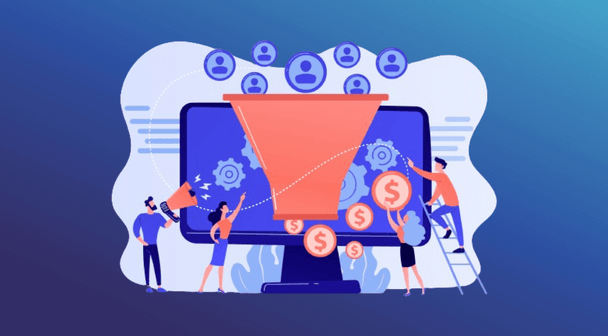
The sales funnel is one of the fundamental strategies for any digital marketing professional. It consists of a structured process that guides potential customers from their first contact with the brand to the final desired action. In the context of digital marketing, the sales funnel becomes even more important as it allows you to increase leads and boost online sales. In this article, we explore what a sales funnel is in digital marketing and also present 5 tips on how to use this tool to benefit your online business.
What is a sales funnel?
The sales funnel is nothing more than a visual representation of the customer journey from the moment the consumer discovers your brand to the final stage of conversion or purchase. It is called a "funnel" due to its shape, with a large number of potential leads at the top that are filtered throughout the process. The individuals who reach the bottom of the funnel, i.e., those who reach the final stage, are considered the most qualified to purchase your product or service. This process encompasses 6 stages distributed throughout the funnel:
Top of the funnel:
1. Awareness
In this stage, consumers are in the first phase of discovery, so although they are researching information about a need or problem, they still do not know your brand. This is the broadest area where, although there may be a large number of visitors to your website, they may not become leads.
Middle of the funnel
2. Interest
Here, the consumer has already recognised the existence of a problem or opportunity and, therefore, begins to explore their options. Now your brand becomes a possible solution, but the search for information continues and no option is ruled out, comparing different alternatives of products or services.
3. Consideration
During this stage, the consumer actively considers your brand. Here, your offer is subject to direct comparison with others available on the market, meaning the individual evaluates the advantages and disadvantages of the various options so that they can later "rank" them in their mental list.
4. Intention
In this phase, leads show signs of purchase intention. As such, they are likely to be interacting more with your content, for example by signing up for newsletters, requesting quotes, or asking for demonstrations.
Bottom of the funnel
5. Decision
Finally, at the bottom of the funnel, consumers are about to make the purchase. To do so, they make a final reassessment of prices and reviews to ensure they are making the right decision.
6. Action
Finally, in the last stage of the sales funnel, leads convert into consumers of the brand and complete their purchase process with the desired action, whether it be purchasing a product, signing up for a service, scheduling a demonstration, etc.
Now that you have an idea of how the consumer journey works, here are 5 tips to maximise your sales funnel and adapt your digital marketing strategy:
1. Know your target audience
Before building your sales funnel, it is essential to know your target audience. In addition to gathering sociodemographic data, it is important to understand what the main challenges and problems of these individuals are. This will allow you to create content and offers that make sense for them at each stage of the funnel.
2. Create relevant content for each stage of the funnel
Creating good content is always rewarded, especially online, as the content available daily is abundant. It is crucial that for each stage of the consumer journey you take care to produce persuasive, high-quality content that allows you to stand out from the competition.
3. Automate and personalise your approach
There are a number of marketing automation tools you can use to segment leads based on demographic, behavioural or engagement characteristics. For this, we recommend HubSpot, which also allows you to create automated workflows for lead nurturing. If you wish to develop newsletters, you can use Mailchimp for email marketing automation and contact list segmentation.
4. Optimise the experience at every touchpoint
Ensure your sales funnel journey is successful across all channels and devices. Spend time improving the consumer experience, from your website and landing pages to your social media and email. This is essential to maintain a positive customer experience and help leads move through the funnel.
5. Monitor and adjust constantly
Regularly evaluate the performance of your sales funnel by analysing metrics such as conversion rate, abandonment rate and average time on the website. Then use these insights to adjust and optimise the consumer experience and your digital marketing campaigns.
Conclusion on the digital marketing sales funnel
In conclusion, a well-built and effective sales funnel is crucial to the success of any digital marketing strategy. By understanding how each stage of the funnel works and knowing your target audience in depth, you can optimise and personalise the customer experience. To do this, you should use marketing automation tools and provide valuable content at each stage of the funnel, in order to maximise your business performance and achieve success.